Showing posts with label EAI. Show all posts

Wednesday, February 16, 2022

Future of Enterprise Application Integration(EAI) Middleware


There are various types of middleware in software industry. This blog limits the scope to EAI middleware that is widely used in enterprises. This type of
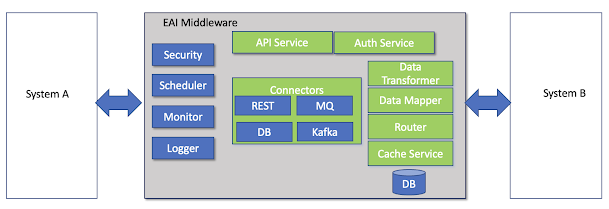
  middleware adds integration capability to a functional system that end users interacts with. It offers connection to heterogeneous systems, data transformation, fields mapping, routing logic and sometimes rule engine.  Technical teams also prefer middleware to unload certain heavy operations from main functional systems. 

Typical functionalities of EAI middleware

Tuesday, November 16, 2021

EAI Tool Building With IBM Public Cloud Services

There are plenty of EAI middleware tools in the market. Why build a new one in that case? The answer for this question is always debatable with various reasons cited like complete control on the tool, extensibility, customizable to your own unique use cases and of course low pricing. The low pricing part is more tempting with cheap cloud infrastructure, varying loads, and fast changing business dynamics supporting the justification process. 

If you are convinced that low price is the most sought out, don't forget to check important features that any EAI tool would perform and compare that with your requirements. Every popular tool in market pretty much offers basic features like minimal coding, quick mapping, real time/batch mode, multiple connectors, retry mechanism, error handling, monitoring, and reports. There are niche features like AI based data mapping or integration that some modern tools provide. If you are looking for most basic features and you don't want to end up learning yet another tool, its time to try IBM Public Cloud(IPC) services for developing your own EAI tool.

The microservices based containers over cloud architecture provides mechanism for building such tool quickly and efficiently. There are multiple offerings by IBM public cloud to support such requirements. There is a Cloudpak that comes with perfectly packaged services to quick start the journey. Other hand,  there are individual services right from computing clusters to database that you can cherrypick to build your own infrastructure package. 

I want to share my experience of setting up my own services and how easy it was. To start with, I wanted all the basic features that are mentioned above in the tool. Few requirements that I focussed are:

  • Integration options that was demanding REST API, Kafka and DB integration. So there is a clear need of multiple connectors
  • Data sync interval - Realtime is the requirement in my case
  • Exclusive data mapping with heterogeneous applications need to be integrated
  • Assured delivery - Can't miss even a single transaction 

The above requirements clearly pointing to the kind of system needs to be developed that includes :

  • API server to listen to calling application - A microservice with light weight server needs to be developed here
  • Independent connectors to connect to API, Kafka and DB of applications - Utility backend microservices for providing connection and retry logic 
  • Data Processor - Yet another microservice that process the data and prepares the mapping to a specific target system
  • A database that can persist data temporarily in case of connection issues
Techno-Functional overview


Development Effort

Listing the effort required to setup for fulfilling above requirements.

IPC infra overview

Minimal IPC Services required:
  • IKS cluster with 3 nodes  and PV - To develop microservices
  • MongoDB - NoSQL DB for temporary persistence
  • LogDNA - Log analysis for debugging purpose

Developing Microservices

Setting up Redhat Open Shift (ROKS) or IBM Kubernetes Service(IKS) to build cloud native containerized microservices takes not more than 20 minutes. This includes all operational tasks like creating separate resources for test and production environment.

The technology used is Python with Flask. Connectors are the main services that would take longer time as it requires end to end testing, retry mechanism to handle errors etc. using different integration approaches. 

Microservices created:

  • Three different connectors for DB, Kafka and REST API
  • Auth server for OAuth2.0
  • API server to receive requests
  • Data processor that handles mapping, transforming and orchestration
CronJob scheduler is created to handle error retries at regular intervals. 

MongDB Collection Setup and LogDNA setup

MongoDB is a quick setup with simple collection creation to store the failed records for later retries. LogDNA for logging analysis is also a fairly easy setup before you start coding and adding log statements.

DevOps Setup

  • Github setup is not part of Cloud services and it needs to be done separately 
  • Jenkins comes by default with ROKS. So you can quickly develop pipelines with the stages you need using groovy scripts. I added unit test, test coverage, static code analysis, build, and publish to image repository in CI pipeline
  • Separate test and production environment would take duplicated effort
  • Yaml files for shared configuration or Vault setup to manage secrets

Deployment Setup

Deployment task was setup as part of CD pipeline in Jenkins. Each microservices Yaml are created with 200m cpu and 256Mi memory limits and deployed with maximum 3 replicas based on 70% CPU utilization. Scheduler is created as cronjob and scheduled to run on specific intervals to check and process error records. 


Conclusion

The details shared above are at high level and the low level details would define the exact effort required. My intention is to share this as quick reference material as I experienced the easiest way of middleware development using IBM public cloud services. 


Wednesday, May 29, 2019

Error Handling in Application Integration

Error Handling in Application Integration


Application integration not always comes with happy paths irrespective of domains and the mechanism adopted. More and more enterprises are adopting micro services that calls for integration of various applications in real time. Not always this integration result in successful data flow due to various reasons that includes business, application and network errors or limitations. Handling such failures in real time is critical to the functioning of systems and fulfill the assured delivery requirement. Understanding the types of errors/failures, processing, retrying and transforming provides higher rate of success.

The areas or activities that need to be looked into solve this problem are listed below:
  • Identifying the errors
  • Defining error categories
  • Formulating recoverable and non recoverable errors
  • Defining workflow steps - Automated or Manual 
  • Retry mechanism for recoverable errors
  • Persistence logic for long term recovery
  • Message reconstruction process
  • Defining manual intervention process

Usecase with REST API integration

Error Identification and Categorization


400 category : User Input Error(System related)
•401  - Authentication issue : Retry for getting fresh token. Even after fails, then send alert.
•404 – Retry logic required
•403 – May be one time retry and then Alert

500 category – Internal Server Error (Business validation related)

•For messages, it is important figure out all the codes from target systems.
•Important to find out if the error codes is common or specific to each type of data invalidation in each spoke. We have to start only from the codes. 


Recoverable and non recoverable errors

Errors like temporary network failures, application maintenance downtime can be recoverable. Data validation error requires transformation either automatically or manually depending on the complexity of business rules. Retry logic should be designed such a way to handle these cases individually. 

Retry mechanism for recoverable errors

Picture below illustrates Short term and long term retry logic. 


Circuit breaker design

The simple circuit breaker is used to with short term retry to avoid making the external call when the circuit is open, and the breaker itself should detect if the underlying calls are working again. We can implement this self-resetting behavior by trying the remote call again after a suitable interval, and resetting the breaker if it succeed. This also prevent the unexpected failures with remote calls. 


Persistence logic for long term recovery

The error along with the  message need to be temporarily stored in order to resend the message after the correction has been made to the integration flow. The data model should include: 

Configurable fields for Category Definition:
1. Retry attempt – Number
2. Frequency/duration – Number  - to show minutes
3. Alert required – varchar -  to store email
4. Manual Flag – int -  Manual, Auto, None
5. Priority  - int - High, Medium, Low

These are additional message fields:
1. Status – varchar or int to store Pending, Completed, On Going. – (Message Table)
2. Unique id (Trace ID) - required to identify the error apart from message  object so that we can treat each message differently. This has to be primary key.  (Message table)
3. ID column has to be oppty/LI id. 

Defining manual intervention process

There are errors that cannot be resolved automatically by program logic. This kind of error call for manual intervention. For example, if target system is expecting alpha numerical value for certain mandatory field and source system sends numerical value, the synchronization fails in this case. Unless the value is changed to meet the target system, it is not possible to make the flow successful. User intervention is required most of the time to correct the data or system. Every such cases needs be identified, processes to be well defined and messages handled accordingly before resending the message.   

Conclusion

Few other areas that need to be included are Scheduler for triggering the long term retry, message reconstruction process, and  alert/notifying mechanism. With these systems in place, it becomes easy and manageable to handle both expected and unexpected error scenarios. 
Application integration is never complete without robust error handling process and the benefit of that is enormous. Happy to assist further and take your feedback especially the improvements that you could think of.